The Graph Show
Launched in 2020, the first show devoted to graph databases
With your host : Josh Shinavier
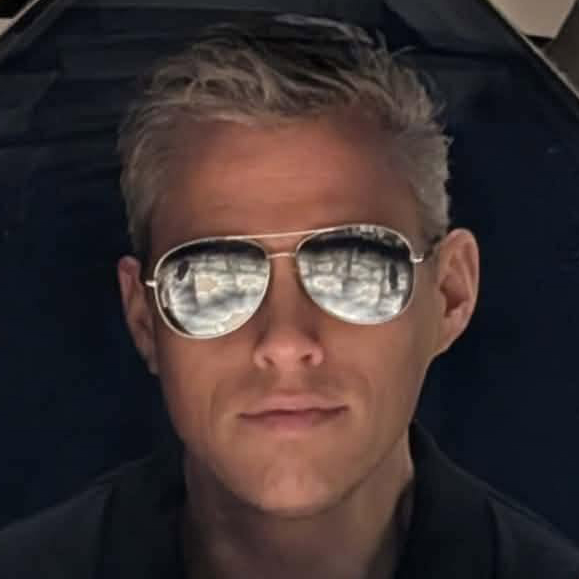
Joshua Shinavier is a primordial being of the graph database domain - and an ontologist since before the graphs.
Josh came up through the linked data movement in 2007, writing a scripting language called Ripple that embedded its programs in the graph. As co-founder of what is now Apache TinkerPop, Josh contributed the first common APIs for graph databases, as well as the original TinkerPop query language, which influenced Gremlin. Josh also created the first tools to align the property graph and RDF data models, starting with neo4j-rdf-sail in 2008.
Josh holds a PhD in computer science from the Tetherless World Constellation at Rensselaer Polytechnic Institute, where he took the opportunity to explore the strange no man's land between graphs, cognition, and augmented reality.
At Uber he built Dragon, the schema integration system behind data integration and graph construction at Uber scale. Its open-source descendant is Hydra - a strongly typed intermediate language for data, schemas, and code, and an ontology language, built on a data model called LambdaGraph, which establishes an isomorphism between labeled hypergraphs and typed lambda calculus. In Hydra, programs are graphs and graphs are programs. Write a program once, in whichever of nine supported languages you like, and the same logic runs in all of them - each able to regenerate the others from scratch. Hydra is heading for 1.0 and the Apache Incubator.
He feels, now as always, that the research, business, and open source communities have a lot to learn from each other with respect to graphs and knowledge representation.
Jans Aasman : Property Graphs vs. RDF Graphs
Episode 1, November 2020. Watch on YouTube
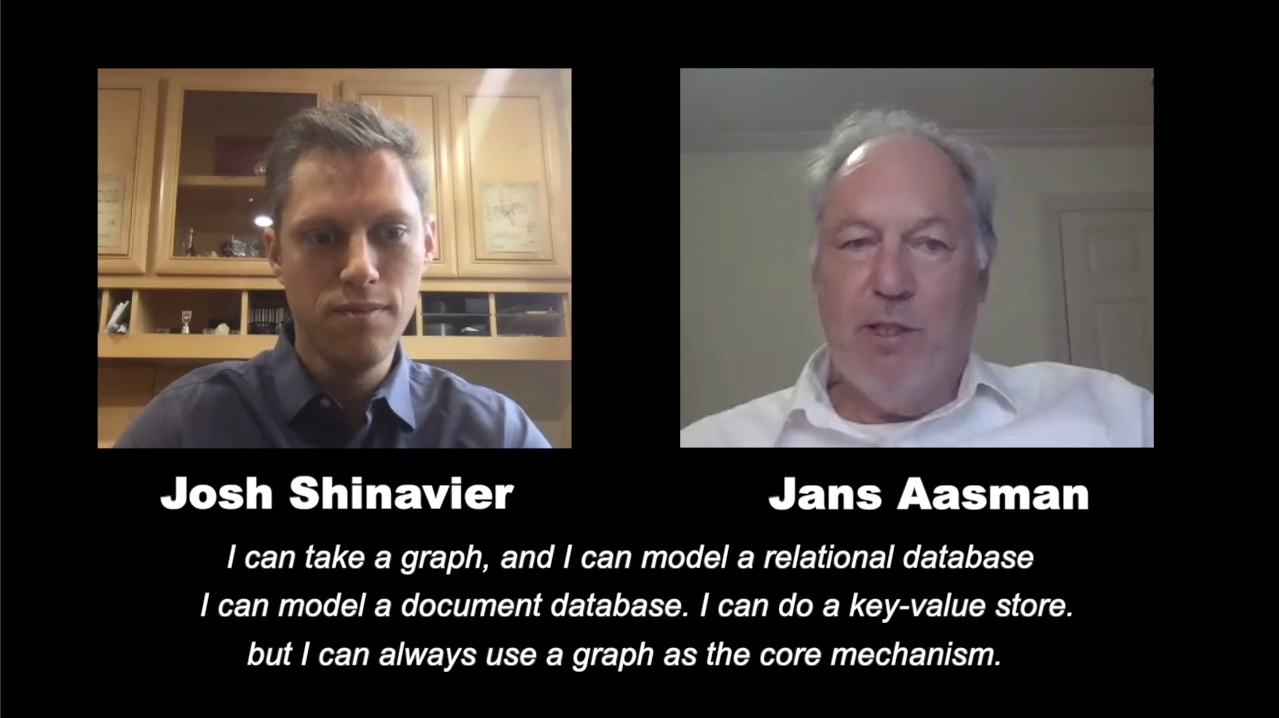
Jans Aasman is CEO of Franz Inc., makers of AllegroGraph - an RDF graph database since way back.
Josh began by saying that for serious integration work he recommends RDF. Jans' argument is that the difference isn't technical. Either model can do what the other does. It's culture and discipline. Give three developers a graph problem and three months, and they'll take the tool they can start with today - and ship you a new silo. Nobody asked them to think about the other forty applications in the building. The people who should be choosing are the architects, not the programmers.
Then the line that stuck: everyone Jans sells big semantic graph projects to is over forty. They've seen the pain of silos. The brilliant young programmers can solve anything, and it never occurs to them to ask how their thing will talk to everything else.
Josh and Jans also discuss why the early semantic web priced itself out - when reasoning was academic and OWL wanted an IQ of 130 - and why only about a tenth of Franz's customers care about reasoning now, most of them in life sciences. Jans predicts the two worlds converge within ten years. Josh asks whether RDF's culture can be taught to the property graph side. Neither of them is sure.
Denise Gosnell : Graph Thinking / The Practitioner's Guide to Graph Data
Episode 2, November 2020. Watch on YouTube
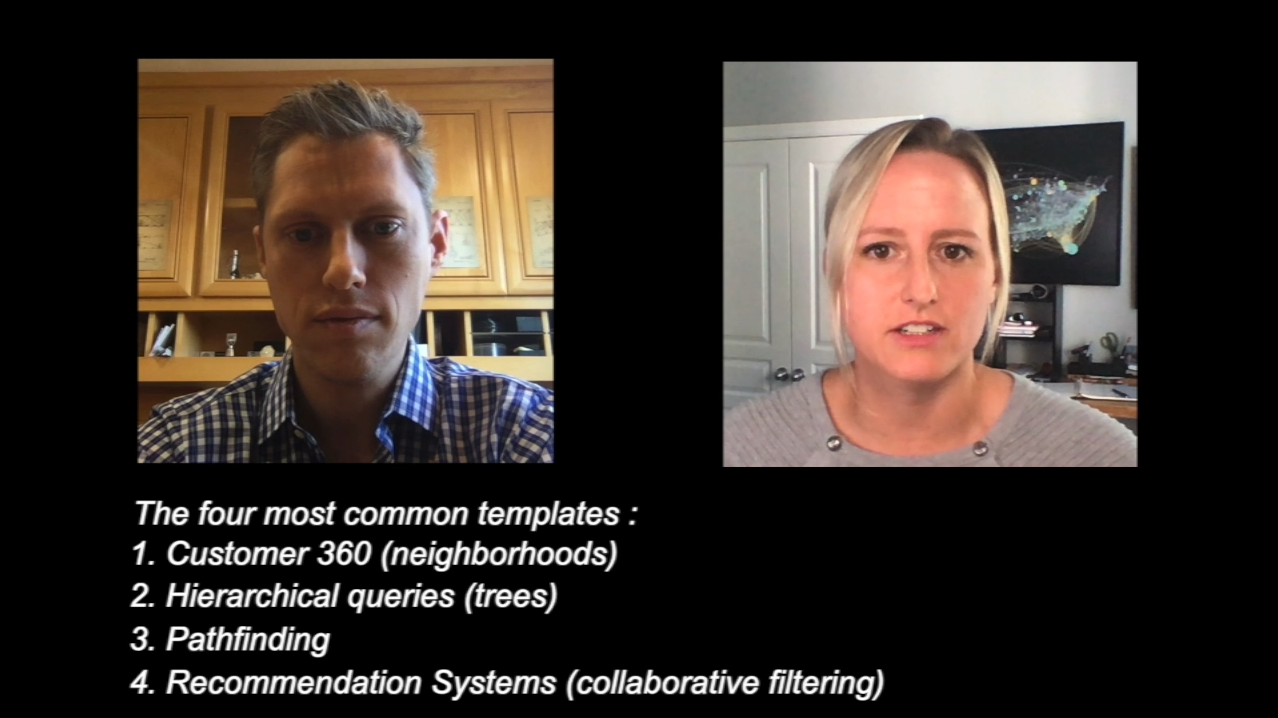
At the time of this interview, Dr. Denise Gosnell was Chief Data Officer at DataStax, and had just co-authored The Practitioner's Guide to Graph Data (O'Reilly) with Matthias Broecheler.
Graph thinking, as demonstrated in their book, is the way you already hold data in your head. You look someone up on LinkedIn and there's a badge telling you how you're connected. Nobody had to teach you to read it.
The numbers make the case better than the theory. A large US insurer had a customer 360 running in SQL - one query, about 130 lines, most of it joins. Migrated to a property graph and written in Gremlin, it came to 18. Shorter to maintain. A different mindset to understand.
Denise and Matthias worked with hundreds of teams and found the same four templates coming up, in this order: neighborhoods, hierarchies, pathfinding, recommendations. Each template in the book carries a schema, the business questions it answers, and the Gremlin to answer them. Her warning is the useful part - everyone has the moment where they realize the whole world can be modeled as a graph, and that grand idea is exactly where projects die for lack of a specific outcome. She lost one that way.
Josh and Denise close on explain and profile, which Denise calls the most underutilized steps in Gremlin - and on the bitcoin trust network in the book, where proving you have the shortest path means understanding what a barrier does to your traversal.
Ryan Wisnesky : From Knowledge Graphs to Knowledge Categories
Episode 3, November 2020. Watch on YouTube
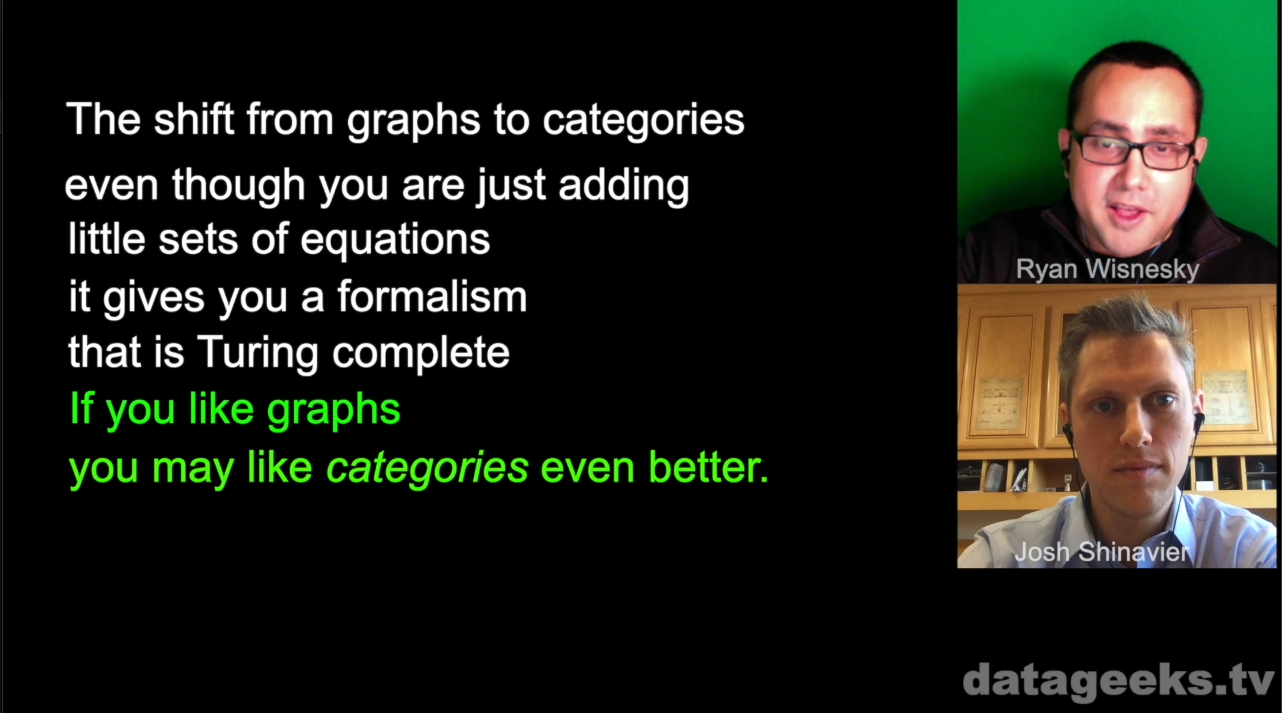
Ryan Wisnesky came with slides, and said so up front - category theory is where things have to be written down or nobody knows what they're talking about.
A category is a graph with extra structure. Objects and arrows, which are nodes and edges. Then three additions: you can compose any two arrows that meet tip to tail, composition is associative, and every object has an identity loop. That's it. The meaning lives in the composition, not in the objects - as Ryan puts it, category theory is about how things relate to each other rather than what they are. It was invented after the war to let one branch of mathematics borrow results from another.
From there the conversation gets practical. A construction of Grothendieck's turns tabular data into a literal graph. Follow a foreign key instead of joining a table to itself twice. And every query you write can be run backwards - not inverted, since a query that throws information away can't be undone, but round-tripped, so you can say exactly how far you are from where you started. (That type of relationship is called an adjunction.)
Ryan goes on to discuss concrete examples of where this is useful: migrating one schema to another, two banks exchanging financial data, two versions of an avionics package where the difference is an update you want to apply automatically, a physicist's data that a chemist needs. Most of ETL, formalized. And schema integration, where the math tells you how the merge should go rather than leaving it to judgment.
The second half of the interview focuses on the work Josh and Ryan did together - algebraic property graphs, a categorical account of what it takes to standardize schemas at scale. The paper is on arXiv.
The interview was recorded live, with questions from the audience throughout.
Ruben Verborgh : What is a Personal Knowledge Graph?
Episode 4, January 2021. Watch on YouTube
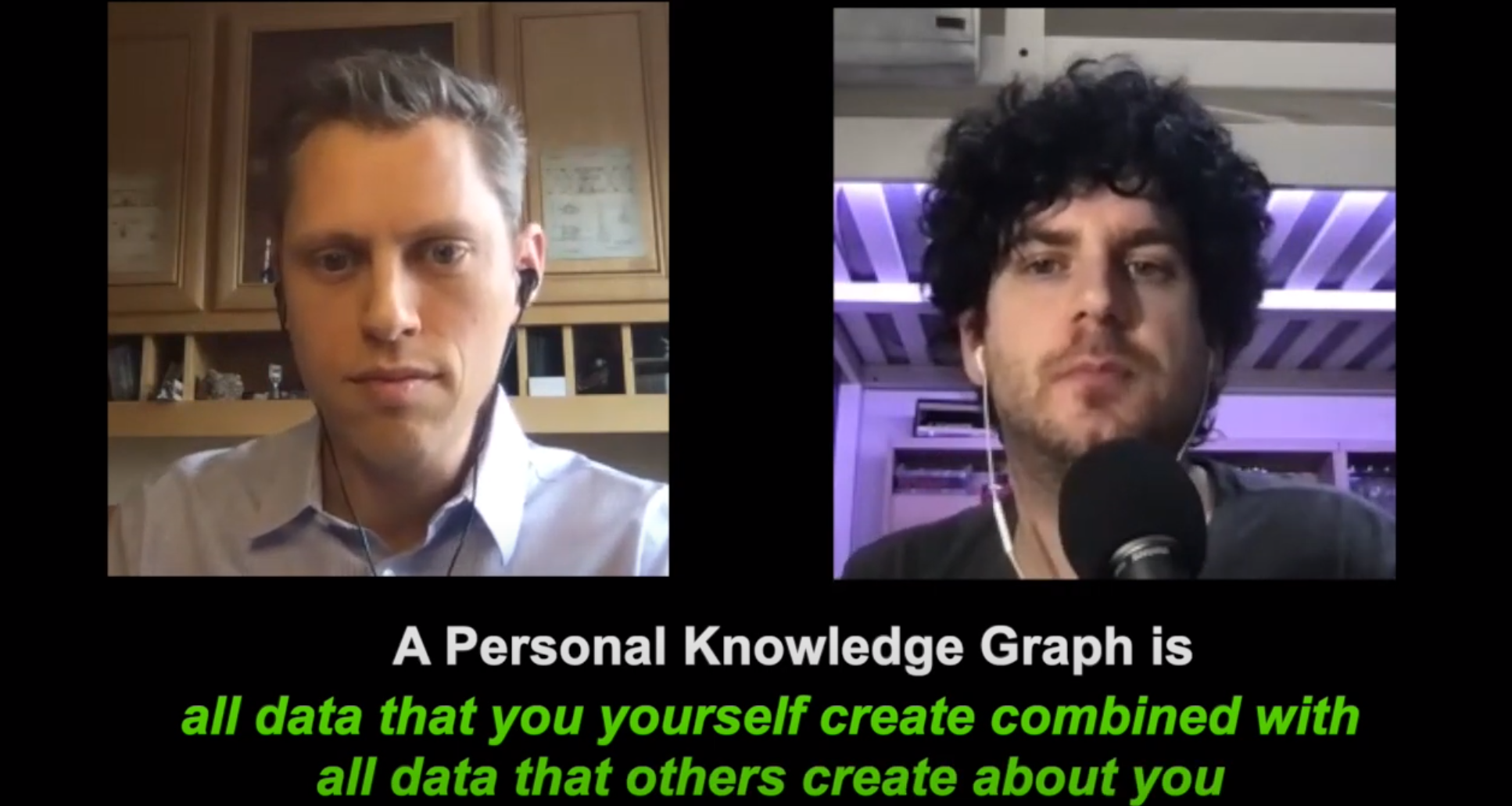
In this episode, Ruben Verborgh, a professor of decentralized information at Ghent University, joins Josh to discuss his work on Solid, the decentralized web project Tim Berners-Lee started at MIT.
Ruben describes a personal knowledge graph as everything you create, plus everything others create about you. Solid provides an infrastructure for personal knowledge graphs.
Regarding privacy, Ruben thinks we've been arguing about the wrong thing. Privacy is a consequence of control, and by arguing about privacy settings we've accepted a world where we have settings but not control.
Instead of handing your first name and your photo to every service, Ruben proposes a data vault - your data stays with you, and applications retrieve it only when you let them - and then the question of which app owns which data stops being a question.
Ruben goes on to discuss how RDF got its reputation for complexity, and the concept of ownership with respect to data (it's meaningless) - and more.
Alastair Green : GQL, the proposed query language for property graphs
Episode 5, February 2021. Watch on YouTube
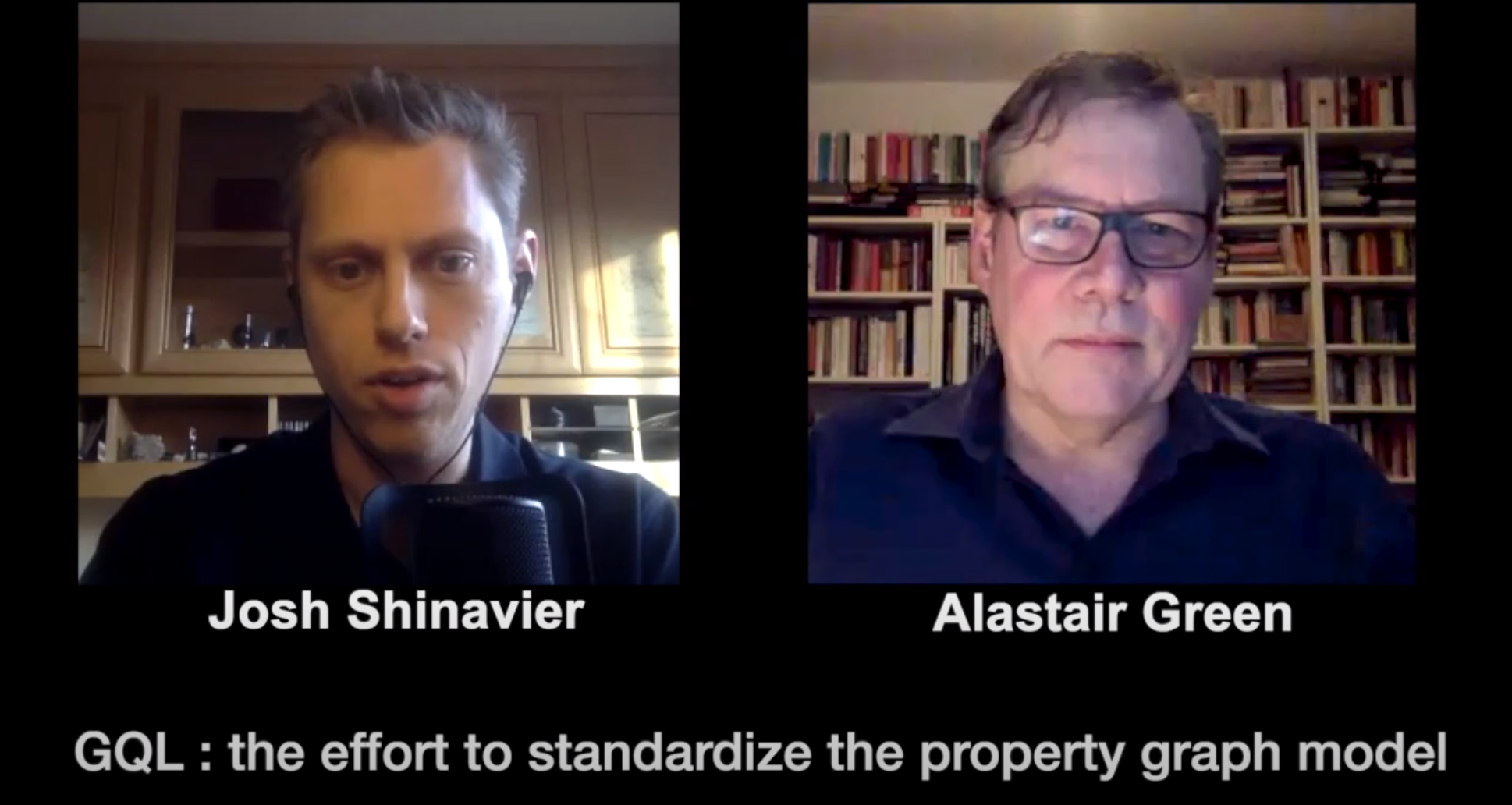
Alastair Green is vice chair of the LDBC. He wrote the GQL Manifesto in 2018, asking the community whether anyone wanted a standard property graph query language. The response was overwhelming - and so the project formally began in September 2019 - at the same ISO committee that maintains SQL.
Alastair's account of why this is happening now is the interesting part: RDF got its standards first and its products second. The thinking went into the specification, and the implementations followed. Property graphs went the other direction. They came from practitioners - which meant that they got popular because developers found them easy to reason about - which also meant that the standards lagged a decade behind the products. And the differences are everywhere - whether labels go on edges or only nodes, whether an element can carry more than one, whether meta-properties exist at all. TinkerPop has them. Cypher doesn't.
How much should a standard let you do? Edges on edges, hyperedges, arbitrary trees hanging off every value - all possible - and all corrosive to the simplicity that made property graphs popular. Alastair's position is that the standard is a substrate rather than a ceiling. Build the floor, and let people build up from it.
Alastair's comment on schemas is worth making note of: Developers love the freedom of a graph with no schema, right up until the thing matters to the enterprise - and then they want to turn the water into ice. GQL has to work at both ends, and at the rungs in between.
Alastair goes on to tell the story of the March 2019 workshop in Berlin, sponsored by the W3C, where the RDF and property graph communities sat in one room. Attendance was capped at about a hundred and twenty; more wanted in. The conclusion everyone reached was that you can't build the bridge until both banks exist. RDF-star and SPARQL-star on one side, GQL on the other, and mappings once there's something to map between.
Josh and Alastair close on composability, which may be GQL's most consequential ambition. Every SQL query returns a table you can query again. Cypher and PGQL stop at tabular output. A graph query language that returns graphs gets you graph views - and a whole class of things nobody can do yet. Great episode.
Olaf Hartig : RDF-star
Episode 6, April 2021. Watch on YouTube
Olaf Hartig is Associate Professor at Linköping University and author of the RDF* proposal. RDF-star, née RDF*, is part of the RDF-DEV community group.
Stephen Mallette : TinkerPop
Episode 7, July 2021. Watch on YouTube
Stephen Mallette is an Apache TinkerPop committer and PMC chair - which makes this the episode where the project's current steward sits down with one of its co-founders.
Scott Meyer : The Liquid Graph Database
Episode 9, August 2022. Watch on YouTube
Scott Meyer of LinkedIn is the creator of the Liquid graph database, which sits behind LinkedIn's Economic Graph.
Leo Meyerovich : Graph Intelligence
Episode 10, August 2022. Watch on YouTube
Leo Meyerovich is the founder of Graphistry. Leo wrote about graph intelligence with Ben Lorica on the Graphistry blog.
Tomás Sabat : TypeDB
Episode 11, November 2022. Watch on YouTube
Tomás Sabat of Vaticle, creators of TypeDB and TypeQL.
The Graph Show is produced by Global Data Geeks. The full archive is on the Global Data Geeks YouTube channel.